The Master's degree reform necessitated the Aalborg University (AAU) rethink and adapt the range of degree programmes, most recently at the Faculty of Social Sciences and Humanities (SSH). On Wednesday 19 November, the Executive Management approved the SSH Dean's Office’s adjusted plan for programme closures, which means that five Master's and three Bachelor's programmes will be recommended for closure once there are no more students enrolled in these programmes.
"All four faculties at AAU have now prioritized and focused their programme portfolios, and thus solved the societal task put to us with the education of fewer young people at the universities. The same way we solved the task in the mid-00s when society wanted more young people at the universities," says Rector Per Michael Johansen.
Continued strong SSH
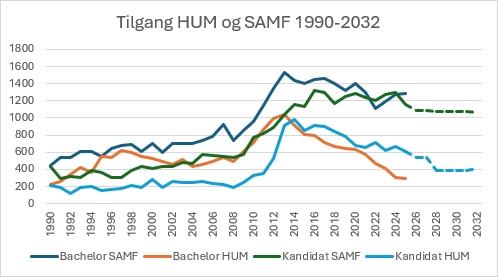
This development in admissions means that, for example, for the humanities main area, admissions to Master's programmes in 2028-32 are stabilized to a slightly higher level than in 2010, before there was a significant increase in admissions in 2012-2014 (see also fact box at the bottom of the article).
Even though we are facing necessary adjustments in our programme offerings, it is important for me to emphasize that Aalborg University continues to be – and will be – a broad university. In the coming years, we will invest in continuing to have strong, committed academic environments across both the humanities and social sciences, and SSH will still be the faculty at AAU that admits the most students," says the rector.
"The changes we are now implementing are to ensure that we can continue to offer relevant, sustainable degree programmes in the future, while maintaining the breadth and quality of our university," he adds.
The final plan
The Executive Management decided that admissions to the following five Master's programmes will be closed with a view to programme closure when there are no more students enrolled:
- Applied Philosophy
- Human Centred Informatics
- Interactive Digital Media
- Experience Design
- Social Science (Samfundsfag)
In addition, AAU will close admissions to the three associated Bachelor's programmes with a view to programme closure when there are no more enrolled students:
- Applied Philosophy
- Art and Technology
- Social Science (Samfundsfag)
Adjustments after comment period
The programme closures at SSH have been the subject of a great deal of attention and debate. After reading all the comments from students, staff and partners, SSH Dean Rasmus Antoft chose to remove Musicology and International Business Communication, English from the list of programmes that were originally recommended for closure.
The two programmes will continue with the changes that the Master's programme in International Business Communication, English will be a 75-ECTS credit programme in the future, and that next year integrating Musicology and Music Therapy to a greater extent will be explored.
The decision was made based on an overall assessment with emphasis on key figures such as admissions, drop-out rates and unemployment rates, regional considerations and the possibility of maintaining a strong study and research environment.
The future programme landscape at SSH
The plan for the future programme landscape at SSH states that the freed-up places from the programme closures as of 2028 will be prioritized for Business Law, Law, Economics and Business Administration, Political Science, and Psychology and Communication.
In addition, the plan includes two new, focused 75-ECTS credit programmes, each with 20 study places. They have the working titles Social & Human Data Science and Digital Design & Information Structure; one implication is that the Master's programme in Communication will not be converted into a 75-ECTS credit programme. In addition, the number of places in the 75-ECTS credit programme in Entrepreneurial Business Engineering will be increased from 13 to 20 places, partly due to positive development in the unemployment rate.
In addition, the Dean's Office proposes that as of 2029 the Master's programme in Communication will be the faculty's entry point for students at the 120-ECTS credit Master's level. Towards 2029, the Master's programme in Communication will be further developed and include various specializations.
The Bachelor's programme in Communication and Digital Media will be further developed so that as of September 2026 and onwards it will be an academic 'basic programme' in the communication area, meaning that students are legally entitled to the 120-ECTS credit Master's programme in Communication with the possibility of specialization in 2029.
Social Science (Samfundsfag) will be retained as a minor subject connected to the degree programme in Political Science.
Development in the number of students at the Faculty of Humanities (HUM) and the Faculty of Social Sciences (SAMF) 1990-2032