News
Simon Bøgh paves the way for life in Space – from sandbox to lunar dust
Published online: 18.09.2025
News
Simon Bøgh paves the way for life in Space – from sandbox to lunar dust
Published online: 18.09.2025
Simon Bøgh paves the way for life in Space – from sandbox to lunar dust
News
Published online: 18.09.2025
News
Published online: 18.09.2025
By Julie Høncke Keldorff, AAU Communication and Public Affairs
Photos: Lasse Møller Badstue
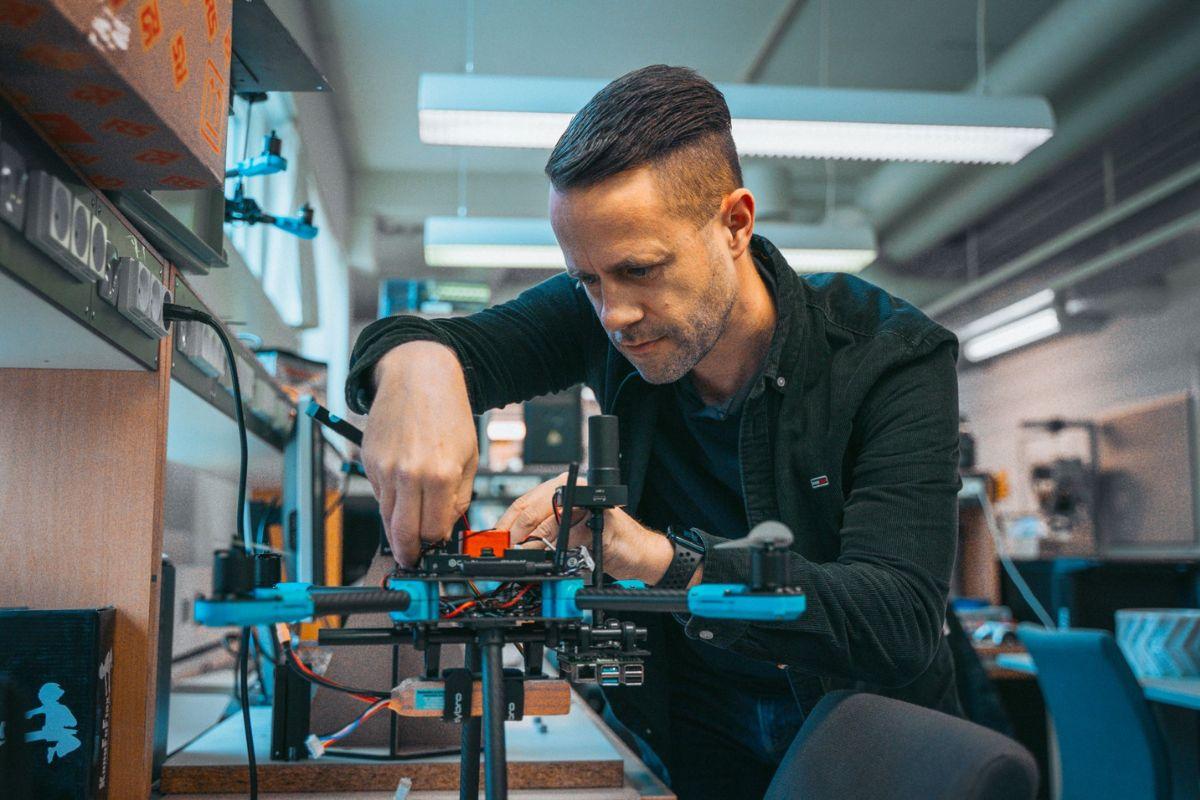
Simon Bøgh has worked with industrial robots for two decades, but his fascination with space goes back even further. During the Christmas break in 2021, he took the first step: he 3D-printed a remote-controlled version of ESA’s Mars rover and used it as the foundation for a teaching project. It was a success, and shortly after, one of his students landed an internship at the European Space Agency (ESA) in the Netherlands. This marked the beginning of the AAU Space Robotics Team, a student-driven organization that now includes over 30 students across eight academic disciplines and competes in international rover competitions.
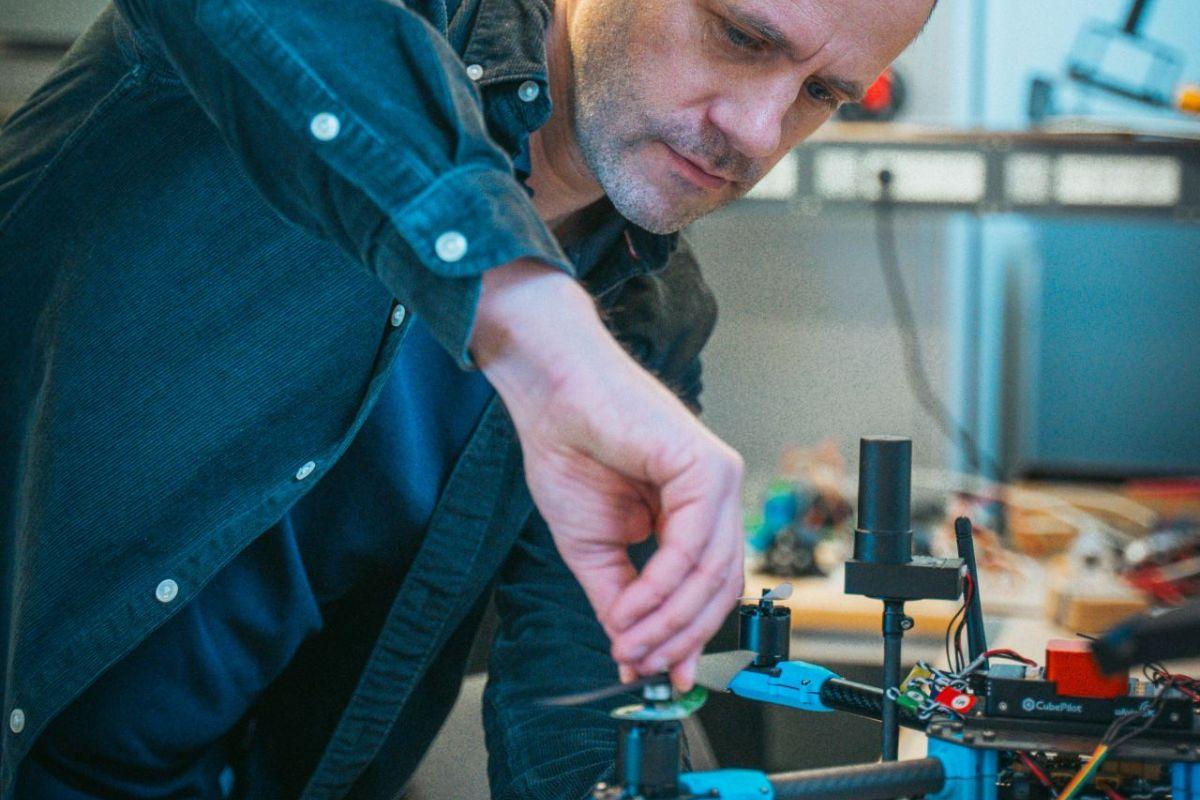
The Space Robotics Lab is more than just a physical space—it’s a vision of developing space technology through collaboration. Here, students and researchers work on robots that must operate autonomously in harsh and unpredictable environments. For Simon, it’s crucial that technology can function independently.
“In space, everything must work the first time. You can’t send a technician if something goes wrong. It requires extreme robustness, simplicity, and full autonomy," says Simon Bøgh.
"And the technology must run on very limited resources – low power consumption and small computers – while still delivering high precision and reliability,” he adds.
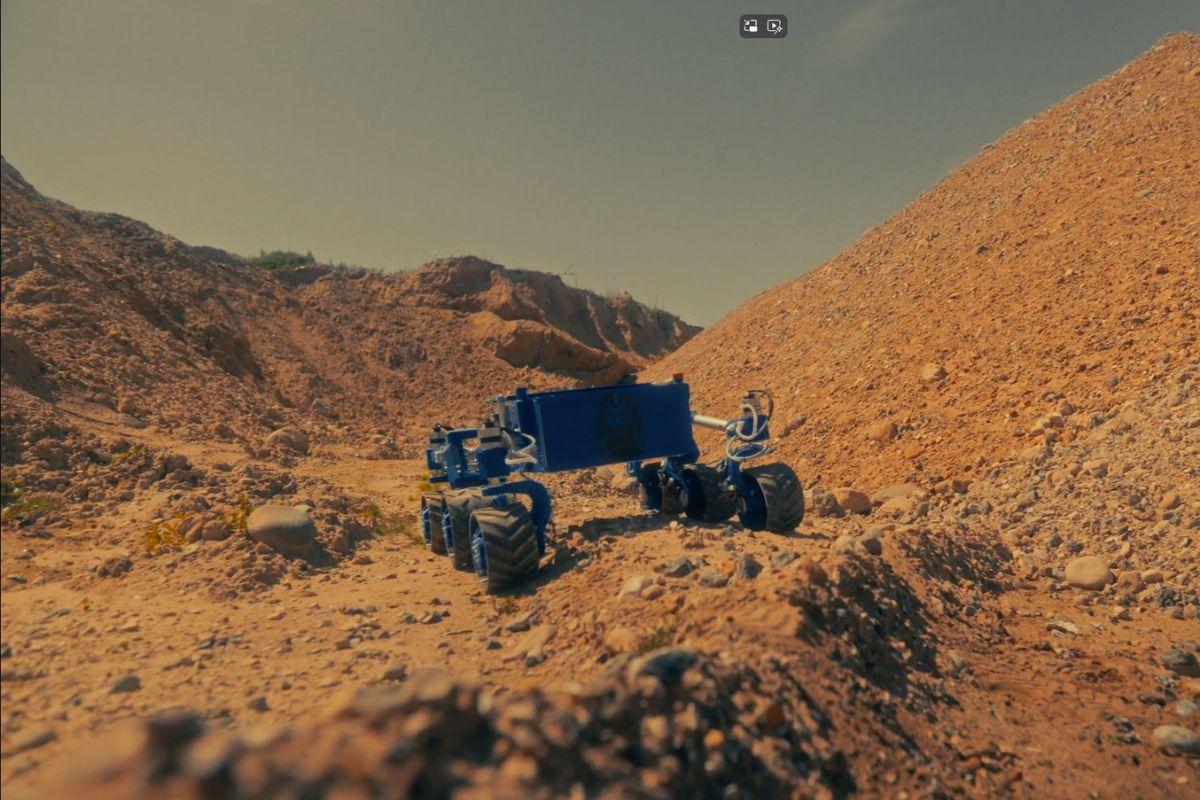
That’s why he and his team develop systems that can learn and adapt along the way. The robots are tested in gravel pits, AAU’s robot playground— a giant sandbox — and on military terrain, all environments that resemble lunar landscapes. They are equipped with “eyes” in the form of cameras and guided by advanced mathematical models that enable them to navigate and act independently.
At the same time, Simon Bøgh is driven by the fact that rocket launches have become financially accessible, allowing universities and companies to participate. In his own words: “Super fascinating.”
In many ways, the dream of sending technology millions of kilometers into space is closer than ever. Simon sees space robots as essential to humanity’s future in space – not as an escape, but to develop alternatives to life on Earth, as climate crises and resource scarcity challenge our current ways of living.
“They must take the first steps before humans arrive. They’ll build habitats, extract resources, and establish infrastructure – all to make the Moon and Mars habitable,” he says.
Together, they are developing a lunar robot composed of three systems: a rover with cameras and a computer, a robotic arm for excavation, and a machine that sorts and processes lunar dust. In October, the technology will be tested at LUNA, ESA’s new 700 m² Moon-like test site in Cologne.
The terrain and dust are simulated, and the best-performing team will be awarded a development contract from ESA. The goal is to make future lunar missions more self-sufficient and reduce the need for costly supply missions from Earth.
Simon Bøgh is currently working on self-learning algorithms to control robots in extreme environments. He’s also involved in two new ESA projects: one focused on camera technologies for lunar rovers, and another on orbital robots that will construct large structures such as space stations and solar arrays. This is technology that can pave the way for humanity’s future in space – and create new solutions here on Earth.
Simon Bøgh has always been fascinated by solving tasks automatically in ways that help people. And the technologies he’s developing can make a real difference on Earth. The robots can be deployed into burning buildings, radioactive zones, or collapsed mine shafts – places where humans cannot safely go. They can deliver supplies in disaster zones and explore the ocean floor.
“When we develop technology for space, we’re also creating solutions that can save lives,” Simon Bøgh explains.
Simon Bøgh’s journey is also a story about Aalborg University and its unique Problem-Based Learning (PBL) approach where collaboration with students and industry is central. “I got new playmates,” he says of his move to the Department of Electronic Systems where space technology has long been a focus. There, he found an environment that accelerates his research and gives room to build something new – both technologically and organizationally.
In October, he will participate in the major space conference at Musikkens Hus in Aalborg where researchers, students, and companies come together around the next wave of European space technology. Here, he’ll share experiences and show how North Jutland has become a key player in space – not just because of technology, but because of the people who build it. As Simon Bøgh puts it:
“I’m looking forward to meeting colleagues from across Denmark and sharing experiences. It’s also a chance to showcase how strong and rapidly growing the space technology and industry in North Jutland really is.”
ESA Space Resources Challenge 2025
In the ESA Space Resources Challenge 2025, Simon Bøgh is the research lead for Team LuMA, one of eight finalist teams in the prestigious competition. The team includes researchers from the Advanced Robotics & AI (ARAI) Research Group at Aalborg University, in collaboration with Maana Electric and the Space Robotics Research Group at the University of Luxembourg.